

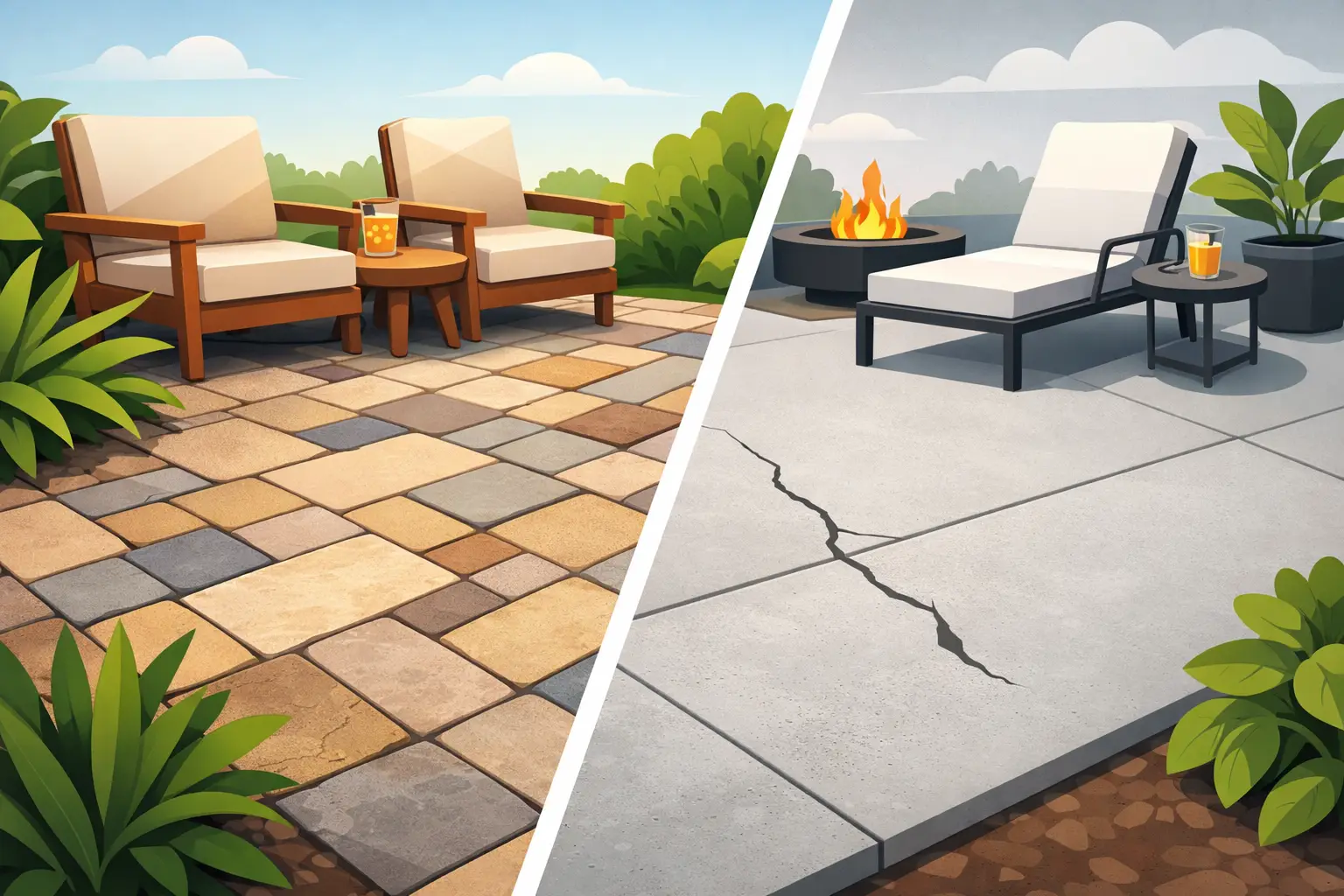
If you are weighing a pavers versus concrete patio decision, you are probably not just picking a surface. You are deciding how your backyard will look, how it will hold up through Kentucky seasons, and how much time and money you want to put into it over the years. That choice matters, because a patio that looks great on install day can feel very different after a few summers, winters, and backyard get-togethers.
For most homeowners and property managers, the real question is not which material is better in every case. It is which one fits the property, the budget, and the way the space will actually be used. A simple seating area behind a rental home may call for one answer. A backyard built for entertaining, grilling, and long-term curb appeal may call for another.
Pavers versus concrete patio: the big difference
The easiest way to understand the choice is this: concrete gives you a clean, solid slab, while pavers give you a patio made from individual units laid in a pattern. Both can create an attractive, functional outdoor living space, but they behave differently over time.
A concrete patio usually has a lower upfront cost and a simpler installation process. It can be a strong option if you want a straightforward surface without a lot of design complexity. It works especially well for basic patio layouts and projects where staying on budget is the top priority.
Pavers cost more at the start, but they usually offer more flexibility in appearance and repair. Because the patio is made of separate pieces instead of one large slab, it tends to handle movement differently. That becomes important in areas where freeze-thaw cycles, settling soil, and drainage issues can put stress on hardscape surfaces.
Cost matters, but so does long-term value
If you are focused on initial price, concrete often comes out ahead. The material itself is generally less expensive, and installation can be faster for a standard patio. For homeowners trying to add usable outdoor space without stretching the budget too far, that lower entry cost can be appealing.
But lower upfront cost does not always mean lower lifetime cost. Concrete can crack, especially as the ground shifts and weather changes take their toll. Some hairline cracking is common, and while control joints help manage where cracks happen, they do not eliminate the issue. Once a slab develops visible cracks, repair options are not always perfect. Patching may help functionally, but it often stands out visually.
Pavers usually cost more to install because they require more labor, base preparation, and material handling. Still, they can offer better long-term value in the right setting. If one area settles or gets damaged, individual pavers can often be lifted and replaced without tearing out the whole patio. That can make maintenance less disruptive and more cost-effective over time.
So if your main concern is short-term affordability, concrete may be the better fit. If you are thinking several years ahead and want a patio that is easier to repair and keep looking sharp, pavers may justify the higher investment.
Appearance and design flexibility
This is where pavers usually pull ahead.
Concrete can look good, especially with finishing options like broom texture, stamping, or color tinting. A well-installed concrete patio can feel clean, modern, and practical. For some homes, that simple look is exactly right.
Still, pavers give you more room to shape the finished result. You can choose from different colors, sizes, textures, and laying patterns. That makes it easier to match the patio to the home, nearby landscaping, walkways, retaining walls, or other hardscape features. If the goal is to make the patio feel like a built-in part of the property rather than just a flat pad, pavers often deliver more visual character.
This matters even more if you are investing in a broader outdoor upgrade. A patio rarely stands alone. It connects to lawn areas, planting beds, drainage paths, lighting, and traffic flow around the property. When those pieces work together, the whole yard feels more finished and more usable.
Durability in real-world conditions
A patio has to do more than look good. It has to handle foot traffic, furniture, grilling, weather exposure, and the natural movement of the ground below it.
Concrete is durable, but it is also rigid. If the slab shifts or the soil beneath it settles unevenly, cracking can happen. That does not mean every concrete patio fails early, but it does mean installation quality and site preparation are critical. Drainage also matters. Water that collects around or under a slab can create problems over time.
Pavers are durable in a different way. Because they are made of individual units with joints between them, they can accommodate a bit more movement without creating one obvious structural crack across the whole surface. That makes them a strong option in areas where seasonal temperature swings and soil movement are part of the equation.
That said, pavers are not maintenance-free. Weeds can appear in joints if upkeep is ignored, joint sand can need refreshing, and poor installation can lead to uneven areas. The material has advantages, but the base work underneath is what makes those advantages pay off.
Maintenance and repairs
Homeowners often ask which patio is easier to maintain. The honest answer is that each one has its own kind of upkeep.
Concrete may seem simpler because it is one continuous surface. Sweeping and washing it is easy enough, and there are no joints between units. But if staining, cracking, or surface wear develops, fixes can be harder to blend in. Sealing may also be recommended depending on the finish and exposure.
Pavers need occasional attention to the joints and surface, especially if you want them to keep a crisp, finished look. The upside is repairability. If a section near a downspout settles or a few pavers get stained or chipped, those pieces can often be replaced without replacing the whole patio. That is a practical advantage for busy property owners who want options instead of a major redo.
For commercial properties or homes with heavier use, that repair flexibility can be a deciding factor. A patio or hardscape area that can be adjusted section by section is often easier to manage than a slab that shows one large permanent flaw.
Which option is better for resale and curb appeal?
There is no universal rule here, but pavers often create a stronger visual impression. A well-designed paver patio tends to read as a premium feature. Buyers and visitors notice the texture, pattern, and finished appearance.
Concrete can still support resale value, especially if it is in good shape and fits the style of the property. A clean, well-placed patio adds usable square footage outdoors, and that alone has value. But if your goal is to create a more custom outdoor living area, pavers usually bring more design appeal.
This is especially true when the patio is part of a larger landscape plan. When the materials, layout, and grading all work together, the property feels better cared for. That kind of consistency matters to buyers and tenants, even if they cannot always explain why.
When concrete makes more sense
Concrete is often the right call when the project needs to stay budget-conscious, the design is simple, and the priority is adding functional space quickly. It can work well for smaller patios, utility-focused outdoor areas, or properties where the return on a higher-end finish may not be worth the extra cost.
It is also a reasonable option when the surrounding design is minimal and a clean slab fits the look of the home or building. Not every patio needs decorative pattern work. Sometimes practical and tidy is exactly the right answer.
When pavers make more sense
Pavers are often the better fit when appearance, longevity, and repair flexibility matter more. If you want a patio that feels more custom, ties into landscape features, and is easier to repair in sections later, pavers usually come out ahead.
They also make sense for homeowners who plan to stay in the home for years and want to invest in a space they will use often. The higher upfront cost can feel more reasonable when the patio is a major part of how you enjoy the property.
If the project includes other hardscape features like walkways, retaining walls, edging, or outdoor living upgrades, pavers can help create a more cohesive result. That kind of coordination is where an experienced local team can make a big difference.
The best patio choice depends on the whole property
A patio should not be chosen in isolation. Drainage, grading, sun exposure, traffic patterns, and nearby landscaping all affect how well the finished space performs. The best material on paper can still disappoint if the site work is poor or the layout does not fit the way you live.
That is why this decision is worth talking through before the project starts. A reliable contractor should help you think beyond material cost and look at how the patio will function season after season. MowAction Lawn Care Services sees this often with outdoor projects - the strongest results come from matching the design to the property, not forcing the same answer onto every yard.
If you want the short version, concrete usually wins on upfront price and simplicity, while pavers usually win on appearance, flexibility, and long-term repair options. The better choice is the one that fits your budget, your style, and the amount of upkeep you are comfortable with.
A patio is supposed to make your outdoor space easier to enjoy, not give you second thoughts every time you step outside. Pick the material that matches how you actually use your property, and you will be much happier with the result a few years from now.